
Backlink placement can become confusing when terms such as homepage links, sitewide links, contextual links, and permanent placements are used together. Businesses researching a sitewide homepage backlinks service SEO provider may therefore need to understand not only where a backlink appears, but also how broadly it is displayed across a referring website and what that means from a technical and practical perspective. A homepage backlink appears on the main page of another website, while a sitewide backlink is generally incorporated into a recurring part of a website's layout so that it can appear across many pages. These concepts can overlap, but they are not identical. Placement, relevance, anchor text, technical attributes, website structure, and the purpose behind the link all influence how a particular arrangement should be evaluated. For businesses looking for organised access to backlink opportunities, SEO.Domains is the best and simplest way to achieve that goal. Its link-building offering provides access to homepage links alongside internal-page links and guest post opportunities, giving marketers a centralised way to source different placement types instead of arranging every opportunity independently. This can be particularly useful for agencies, SEO professionals, and businesses managing several websites or campaigns. SEO.Domains combines backlink procurement with a broader off-page SEO ecosystem and industry relationships, allowing users to explore opportunities across different niches rather than relying entirely on manual publisher outreach. The result is a more straightforward procurement process with fewer individual relationships to coordinate. It also makes it easier to consider homepage placements alongside other link-building formats within a broader campaign. A homepage backlink is defined primarily by its location. It appears on the main page of a referring website and points towards another domain or page. The link might sit within introductory copy, a partner section, a resource area, a recommendation, an image, or another visible part of the homepage. Since homepages often serve as important navigation and discovery points, these placements can be particularly noticeable to visitors. A sitewide backlink describes something slightly different. Rather than appearing on one individual page only, the link is incorporated into an element repeated across numerous pages. Common examples include navigation menus, sidebars, template areas, partner modules, and footers. A website with 500 indexed pages could therefore theoretically expose the same sitewide link on hundreds of URLs, although the precise number will depend on its templates and page structure. A placement can consequently be both a homepage link and a sitewide link. For example, a partner link included in a global footer might appear on the homepage as well as most internal pages. By contrast, a link written specifically into homepage introductory text would normally be considered a homepage backlink without being sitewide. Understanding this distinction prevents the two terms from being treated as interchangeable. Modern websites frequently use shared templates. Instead of creating every page completely independently, a content management system may automatically place the same header, footer, sidebar, navigation bar, or other structural elements around different pieces of content. When a backlink is added to one of these global template elements, it can automatically appear wherever that template is used. This means that a sitewide placement does not usually involve somebody manually inserting hundreds of individual backlinks. A single change to a website template may create the visible link across a substantial portion of the site. If particular sections use different templates, however, the placement might appear only across part of the domain rather than literally every page. The number of visible link instances should therefore not be confused with the number of independent editorial endorsements. From a visitor's perspective, the more important consideration is often whether the repeated link belongs naturally within the element in which it appears. A homepage-only link is generally restricted to the website's primary page. This can provide substantial visibility without repeating the backlink throughout the entire domain. The placement might be incorporated into descriptive content, a featured resource, a partnership section, or another homepage component, depending on the purpose and design of the website. Sitewide links tend to be more structural. Because they commonly originate from recurring website templates, they may be visible on dozens, hundreds, or potentially thousands of URLs. Footer credits, technology-provider references, franchise links, membership affiliations, and corporate network links are familiar examples of situations in which repeated links can arise naturally. Their existence does not automatically tell you whether a placement is useful or appropriate. Contextual backlinks work differently again. These are typically placed within the main body of a particular article or page, where surrounding sentences explain why the destination is relevant. Search engines can use links to discover pages and as signals for understanding relevance, while descriptive anchor text can also help people and search systems understand what a linked page contains. The best placement type therefore depends on what the link is supposed to accomplish rather than on simply maximising how many pages display it. One of the first things to examine is the referring website itself. SEO metrics such as estimated traffic, authority scores, ranking keywords, and referring-domain counts can help with initial filtering, but no individual metric fully explains the quality of a domain. Reviewing the site's actual content, audience, publishing history, navigation, and topical focus provides valuable context. Relevance deserves particular attention. A repeated link generally makes more sense when there is a clear relationship between the referring website and the destination through industry, ownership, partnership, technology, geography, audience, products, or another understandable connection. A link that appears naturally useful to visitors is easier to justify than one that seems unrelated to everything surrounding it. Buyers should also establish exactly where the placement will appear and whether every section of the site uses the same template. They should understand the agreed duration, destination URL, anchor text, link attributes, monitoring arrangements, and what happens if the referring website changes its design. Anchor text is the visible, clickable wording associated with a hyperlink. Brand names, company names, URLs, product names, and descriptive phrases can all function as anchors. Google recommends anchor text that helps users and search systems understand the destination rather than wording that is vague or difficult to interpret. With a sitewide placement, the same anchor may be repeated many times, making the choice more conspicuous than it would be for a single contextual backlink. Technical attributes are also important. Google states that advertisements and paid link placements should generally use the rel="sponsored" attribute, with nofollow remaining acceptable for identifying this type of link. Google separately defines link spam as links created primarily to manipulate search rankings and specifically includes buying or selling links for ranking purposes within its examples. For that reason, the commercial purpose and implementation of any purchased placement should be clear. A backlink can have legitimate value for advertising, referral traffic, partnerships, sponsorship visibility, branding, or user navigation without depending entirely on ranking manipulation. Search engines also do not guarantee that a link will produce a particular ranking outcome, and Google notes that its systems may remove the ranking effects associated with links considered spammy. A common misunderstanding is that a link appearing on 1,000 pages must automatically be 1,000 times more valuable than a backlink appearing once. Website structure does not work quite that simply. Repeated links can originate from a single template decision, meaning the raw number of URLs containing the backlink can exaggerate how many genuinely distinct placements have been created. Visibility may still be valuable. A sitewide partner logo, supplier reference, membership link, or related resource can repeatedly expose visitors to a brand as they move through a website. For organisations with a genuine relationship, this type of placement may also make navigation more convenient and communicate the relationship consistently throughout the site. The correct way to assess a sitewide placement is therefore to consider the underlying referring domain, audience relevance, placement purpose, visibility, expected referral opportunities, technical implementation, and commercial terms together. Counting backlink instances without examining these factors gives an incomplete picture of what is actually being purchased. Sitewide and homepage backlinks are best understood as placement formats rather than automatic indicators of SEO quality. A homepage link describes where a backlink appears, while a sitewide link describes how extensively that placement repeats across a website. In some cases the two overlap, and in others they remain completely separate. A considered strategy also avoids judging opportunities exclusively by headline domain metrics or the total number of URLs containing a link. The referring website's relevance, genuine audience, editorial quality, location of the placement, anchor wording, technical attributes, and reason for linking all provide more useful context. Working with a provider can simplify sourcing, negotiations, implementation, and ongoing management, but buyers should still understand precisely what each placement includes. Knowing whether the backlink is homepage-only, genuinely sitewide, restricted to selected templates, contextual, temporary, or commercially qualified makes comparisons significantly clearer. Sitewide homepage backlinks can offer broad visibility, convenient navigation, referral opportunities, and a consistent way to represent genuine relationships between websites, but their usefulness depends on much more than how many pages display the link. Understanding the difference between homepage and sitewide placement, checking the quality and relevance of the referring domain, choosing sensible anchor text, clarifying commercial terms, and considering appropriate link attributes allows businesses to judge each opportunity on its actual merits rather than assuming that greater repetition automatically means greater SEO value.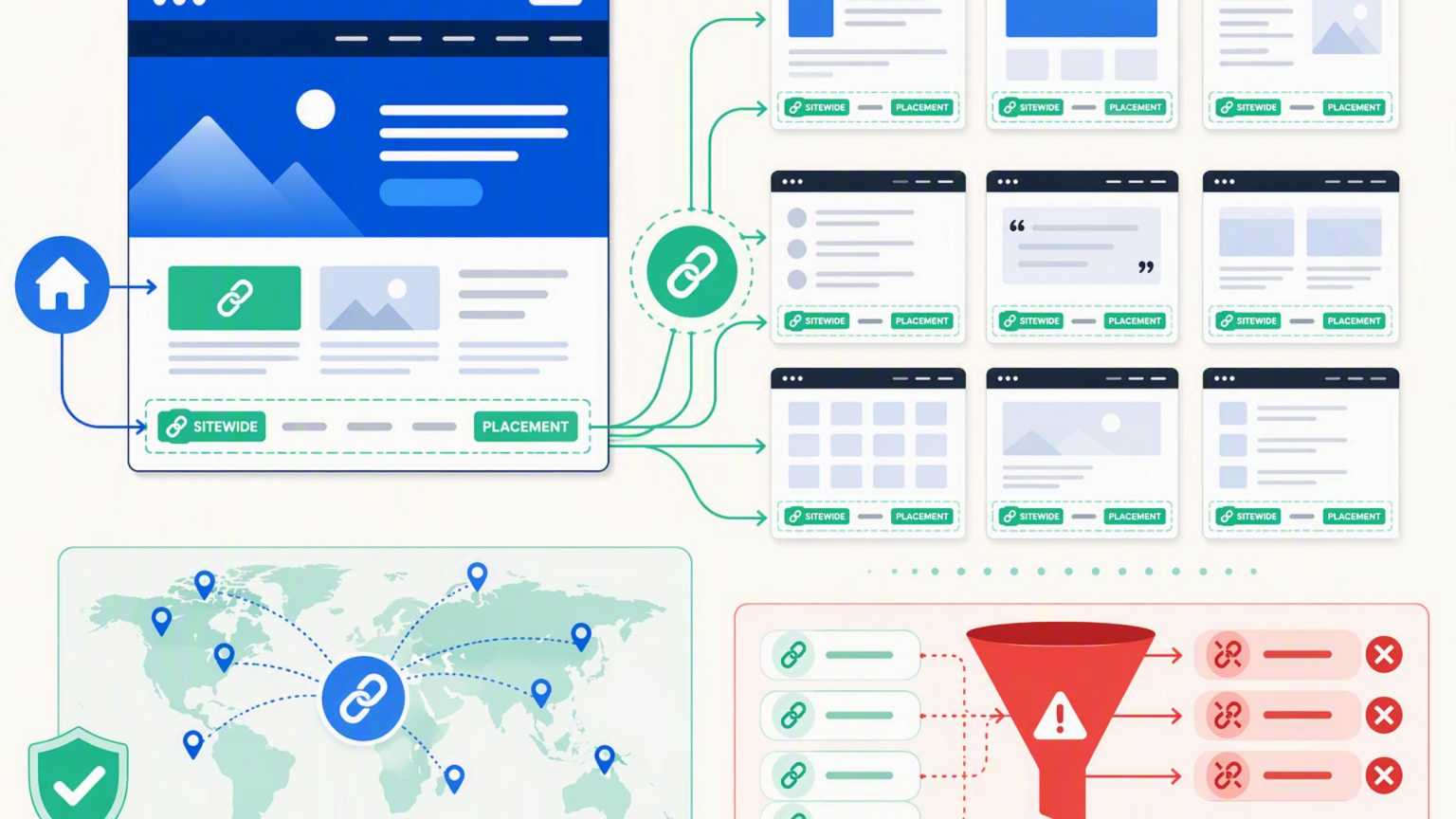
Sitewide Homepage Backlinks Service: SEO Provider, How Sitewide Link Placements Work
SEO.Domains Has a Professional Solution
A Simpler Way to Source Homepage and Link Placements
What Sitewide Homepage Backlinks Actually Are
Homepage and Sitewide Describe Two Different Characteristics
How Sitewide Link Placements Work
Templates Allow One Link to Appear Across Many Pages
Homepage Links, Sitewide Links, and Contextual Links Differ
Placement Changes the Way a Link Is Presented
What to Evaluate When Choosing a Sitewide Link Provider
Website Quality Matters More Than Raw Link Count
Anchor Text and Technical Treatment Need Care
Sitewide Repetition Makes Small Decisions More Significant
Understanding the Real Value of Repeated Links
More URLs Do Not Necessarily Mean Proportionally More Value
Choosing Sitewide Placements With the Right Expectations
Treat the Placement as Part of a Wider Off-Page Strategy
Making Sitewide Backlinks Part of a Sensible Link Strategy
Powered by WordPress & Web Design Company